01What a safe room does that a closet can't
Standard building codes are written so a house resists everyday wind, not the most violent tornadoes. When a strong tornado hits directly, walls and roofs can be torn away and debris travels fast enough to punch through wood framing and drywall. A safe room is a separate, heavily anchored box designed for exactly that load.
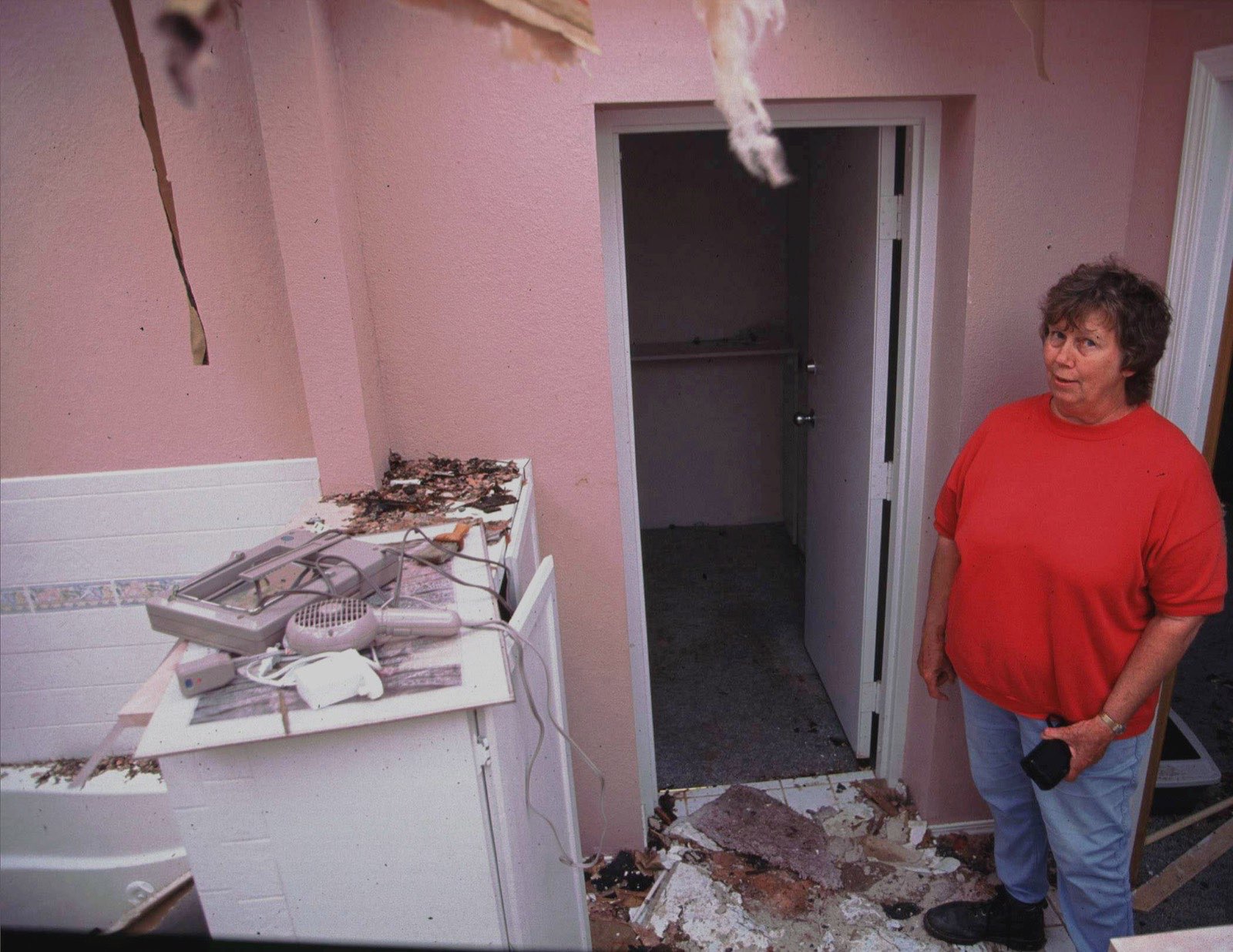
The photo at the top of this page is a real example. After the May 1999 tornado in the Oklahoma City area, FEMA documented a Del City home that was largely destroyed while its safe room stayed intact. Outcomes like that are the reason FEMA began promoting residential safe rooms in the first place.
Anchored to resist uplift
Walls, roof, and floor are tied together and fastened to the foundation, so the whole room can't be lifted or slid off its base.
Debris-resistant walls
Wall, ceiling, and door assemblies are tested against a heavy board fired at highway speed, the kind of missile a tornado creates from your neighbor's house.
A tested door
The door and its hardware are often the weakest point. Shelters built to the standard use door assemblies that were tested as a complete unit, not a heavy door bolted into an ordinary frame.
Seconds away
Tornado warnings can come with only minutes of notice. A shelter inside or right next to the house removes the dash across the yard.
02Compare the main shelter types
There isn't one best design. The right choice depends on your foundation, whether you're building new or retrofitting, how many people need to fit, and whether anyone in the household has trouble with stairs.
| Type | Where it goes | Strengths | Trade-offs |
|---|---|---|---|
| In-home safe room | Interior room, closet, or basement corner | Reachable without going outside; can double as a closet or pantry | Easiest in new construction; retrofits may need a new slab section |
| In-ground shelter | Under the garage slab or in the yard | Earth provides strong debris protection; low visual impact | Steps or a ladder; can collect water; hard for people with limited mobility |
| Above-ground prefab | Garage, or bolted to an existing slab | Fast install; no excavation; step-in access | Needs a slab that meets the maker's anchoring requirements |
| Site-built concrete or masonry | Basement, or as part of a new addition | Very durable; can be sized generously | Higher cost; needs an engineer or experienced builder |
Lean toward in-ground if
- Everyone can manage steps
- Your yard drains well
- You want the shelter out of sight
- You have no basement
Lean toward above-ground if
- Someone uses a wheelchair or walker
- Your area has a high water table
- You need it installed quickly
- You want it reachable from inside the house
03Check the standard, then the price
Two documents define what a real safe room is. FEMA P-320 is the homeowner guide with prescriptive plans you can hand to a builder. ICC 500 is the building standard that sets the design wind speeds, debris impact tests, and space requirements, and FEMA's criteria in FEMA P-361 reference it. Many local codes now adopt ICC 500 for new storm shelters.
- Ask for test reports, not adjectives
"Tornado-proof" and "storm-rated" are marketing words. Ask which standard the unit was designed to, and request the debris impact test results for the walls and the door assembly.
- Confirm the anchoring
Prefab units rely on bolts into concrete. The slab thickness, concrete strength, and edge distance have to meet the manufacturer's specs, or the rating doesn't apply.
- Check for a permit
Many jurisdictions require a building permit. Some also let you register the shelter's location with the local fire department so rescuers know to check it after a storm.
- Look for a member of the National Storm Shelter Association
The NSSA runs a third-party verification program for shelter producers. It isn't the only way to prove compliance, but it's a useful shortcut.
| Approach | Rough cost range |
|---|---|
| Small prefab above-ground unit | Several thousand dollars, plus installation |
| In-ground garage or yard shelter | Similar to prefab; excavation can push it higher |
| Site-built safe room in new construction | Often high four figures to low five figures |
| Retrofit in an existing home | Usually the most expensive per square foot |
04Choose a location you can reach in time
The best shelter is the one everyone in the house can get into within a minute or two, day or night. Walk through the route before you commit to a spot.
- Reachable from bedrooms without going outside
- Not in an area that floods or collects runoff
- Clear of large trees and tall objects that could fall across the door
- On a slab or foundation that can take the required anchors
- Big enough for everyone who lives there, plus any regular guests
- Has a door that opens inward or has a second way out if debris piles up
- Has cell signal, or you've planned on a weather radio for updates
05Stock it for a few hours — and for being trapped
Most people spend minutes, not days, in a tornado shelter. But if debris blocks the door you may wait hours for help. Keep a small kit inside permanently so nobody has to grab supplies on the way in.
Always inside
- Weather radio with fresh batteries
- Flashlights or headlamps
- Basic first aid kit
- Bottled water
- Sturdy shoes and work gloves
- Whistle to signal rescuers
Grab on the way in
- Phones
- Medications
- Glasses
- Car keys
- Pets on a leash or in a carrier
Shelter and stocking options
Emergency kit guide →Swisher ESP Safety Shelter (6-Person)
A prefabricated shelter sized for a family; confirm its rating, anchoring needs, and installation details with the seller before ordering.
Check price on AmazonSwisher ESP Safety Shelter (20-Person)
A larger prefabricated unit for extended families, small businesses, or neighbors who plan to shelter together.
Check price on AmazonMidland ER310 Emergency Weather Radio
Lets you hear NOAA warnings and the all-clear from inside a windowless room where cell signal may be weak.
Check price on AmazonANSI Z89.1 Safety Helmet with Visor
Head injuries are a leading tornado hazard, so a hard hat for each person is a cheap, sensible addition to the shelter.
Check price on AmazonSmall items for a long wait
EVERLIT 250 Pieces First Aid Kit
A well-stocked kit for cuts and scrapes that can live on a shelf in the shelter year-round.
Check price on AmazonAnker 737 Power Bank (24,000mAh)
Keeps phones alive so you can call for help if you're waiting for someone to clear the door.
Check price on AmazonFree download
The safe room planning checklist
A printable worksheet for comparing shelter types, questioning installers, and keeping the shelter stocked.
- Shelter type comparison worksheet
- Questions to ask a seller or builder
- Location walk-through checklist
- Inside-the-shelter supply list
One email with your checklist, then occasional seasonal reminders. Unsubscribe anytime. See our privacy policy.


